
Learning the Quran in a group: why an ambitious class takes you further
By Abdoulaye Mouhidine Sow, director and founder of Rewayah Academy
The Quran has never been so accessible: online, on your phone, in audio, with its explanations and all the sciences around it. Yet many people start and few keep going. The problem is no longer finding something to read. It is starting, and continuing. That is where a guided group changes everything.
Everything is available, and yet we don’t move forward
Today the Quran can be opened in a few seconds on a screen, with many recitations and translations. Classes, talks and explanations abound. This abundance is a blessing; it has not made people more learned for all that. Having access to knowledge does not mean acquiring it.
What is most often missing is not content, but consistency. The Prophet (peace and blessings be upon him) said that the deeds most loved by Allah are those done consistently, even if they are few (reported by al-Bukhari, no. 6464, and Muslim, no. 783 b). These words say exactly what counts when you learn: not one evening’s burst of enthusiasm, but what you are still doing six months later.
أَحَبُّ الأَعْمَالِ إِلَى اللَّهِ تَعَالَى أَدْوَمُهَا وَإِنْ قَلَّ
Alone you start fast; together you go far
A proverb people often quote puts it simply: alone you go faster; together you go further. Someone who learns alone moves at their own pace, but they carry everything: the desire, the regularity, the correction. The day the enthusiasm fades, nothing holds them back.
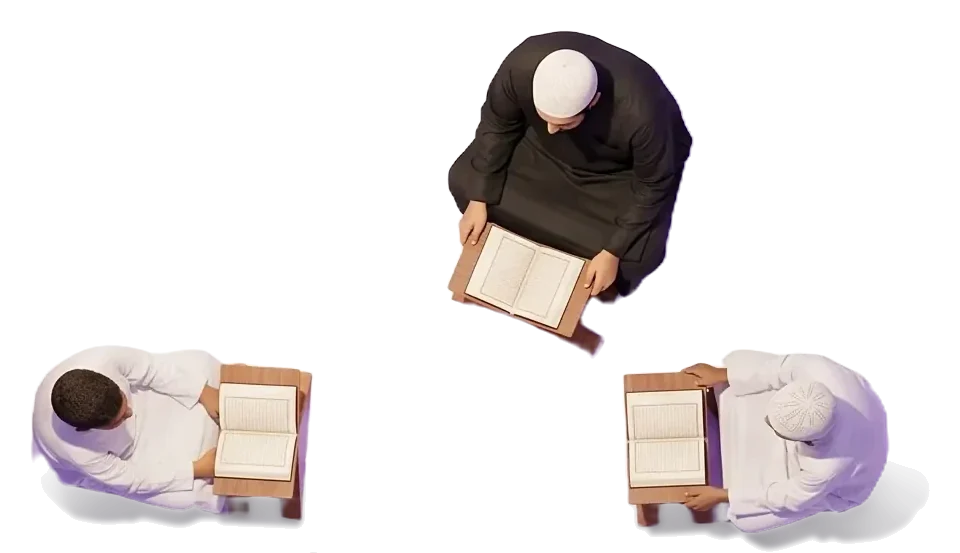
In a group, everyone carries the others a little. You come because you are expected. You prepare because the others will have prepared. You hear a classmate recite a surah you thought was too long, and you tell yourself it can be done.
What tradition says about Quran circles
Gathering around the Quran is a practice that tradition holds in particular honour. The Prophet (peace and blessings be upon him) said that no group of people gathers in one of the houses of Allah to recite the Book of Allah and study it together without tranquillity descending upon them, mercy covering them, the angels surrounding them, and Allah mentioning them to those who are with Him (reported by Muslim, no. 2699 a).
مَا اجْتَمَعَ قَوْمٌ فِي بَيْتٍ مِنْ بُيُوتِ اللَّهِ يَتْلُونَ كِتَابَ اللَّهِ وَيَتَدَارَسُونَهُ بَيْنَهُمْ إِلاَّ نَزَلَتْ عَلَيْهِمُ السَّكِينَةُ وَغَشِيَتْهُمُ الرَّحْمَةُ وَحَفَّتْهُمُ الْمَلاَئِكَةُ وَذَكَرَهُمُ اللَّهُ فِيمَنْ عِنْدَهُ
The Quran also invites us to choose our companions: in Surah Al-Kahf (Quran 18:28), it calls for patience in keeping company with those who call on their Lord morning and evening, seeking His Face. The Prophet (peace and blessings be upon him) compared a good companion to a seller of musk and a bad one to a blacksmith (reported by al-Bukhari, no. 2101; see also al-Bukhari, no. 5534, and Muslim, no. 2628). And he warned that a person follows the religion of their close friend, so each of us should look at whom we take as a friend (reported by Abu Dawud, no. 4833, and at-Tirmidhi, no. 2378; a hadith graded hasan).
وَٱصۡبِرۡ نَفۡسَكَ مَعَ ٱلَّذِينَ يَدۡعُونَ رَبَّهُم بِٱلۡغَدَوٰةِ وَٱلۡعَشِيِّ يُرِيدُونَ وَجۡهَهُۥۖ وَلَا تَعۡدُ عَيۡنَاكَ عَنۡهُمۡ تُرِيدُ زِينَةَ ٱلۡحَيَوٰةِ ٱلدُّنۡيَاۖ وَلَا تُطِعۡ مَنۡ أَغۡفَلۡنَا قَلۡبَهُۥ عَن ذِكۡرِنَا وَٱتَّبَعَ هَوَىٰهُ وَكَانَ أَمۡرُهُۥ فُرُطࣰا
مَثَلُ الْجَلِيسِ الصَّالِحِ وَالْجَلِيسِ السَّوْءِ كَمَثَلِ صَاحِبِ الْمِسْكِ، وَكِيرِ الْحَدَّادِ
الرَّجُلُ عَلَى دِينِ خَلِيلِهِ فَلْيَنْظُرْ أَحَدُكُمْ مَنْ يُخَالِلُ
So a group is not just a convenient way to learn. It is part of how tradition understands knowledge: we learn with others, and we help one another, as the Quran invites us to in Surah Al-Ma’idah (Quran 5:2): to help one another in goodness and piety, and not in sin and transgression.
يَٰٓأَيُّهَا ٱلَّذِينَ ءَامَنُواْ لَا تُحِلُّواْ شَعَٰٓئِرَ ٱللَّهِ وَلَا ٱلشَّهۡرَ ٱلۡحَرَامَ وَلَا ٱلۡهَدۡيَ وَلَا ٱلۡقَلَٰٓئِدَ وَلَآ ءَآمِّينَ ٱلۡبَيۡتَ ٱلۡحَرَامَ يَبۡتَغُونَ فَضۡلࣰا مِّن رَّبِّهِمۡ وَرِضۡوَٰنࣰاۚ وَإِذَا حَلَلۡتُمۡ فَٱصۡطَادُواْۚ وَلَا يَجۡرِمَنَّكُمۡ شَنَـَٔانُ قَوۡمٍ أَن صَدُّوكُمۡ عَنِ ٱلۡمَسۡجِدِ ٱلۡحَرَامِ أَن تَعۡتَدُواْۘ وَتَعَاوَنُواْ عَلَى ٱلۡبِرِّ وَٱلتَّقۡوَىٰۖ وَلَا تَعَاوَنُواْ عَلَى ٱلۡإِثۡمِ وَٱلۡعُدۡوَٰنِۚ وَٱتَّقُواْ ٱللَّهَۖ إِنَّ ٱللَّهَ شَدِيدُ ٱلۡعِقَابِ
An ambitious group, not just any group
Not every group carries you along. A group that meets without a goal, without a schedule and without a teacher often ends up drifting apart. What makes a class strong is a shared aim, a fixed appointment, and someone who guides and corrects.
Healthy emulation has its full place there. The Quran says it plainly: in Surah Al-Baqarah (Quran 2:148), it calls on us to race one another in good deeds. And, about the delights promised to believers, Surah Al-Mutaffifin (Quran 83:26) says that this is what those who strive should compete for. Competing in goodness is not comparing yourself to put yourself down; it is pulling one another upwards.
وَلِكُلࣲّ وِجۡهَةٌ هُوَ مُوَلِّيهَاۖ فَٱسۡتَبِقُواْ ٱلۡخَيۡرَٰتِۚ أَيۡنَ مَا تَكُونُواْ يَأۡتِ بِكُمُ ٱللَّهُ جَمِيعًاۚ إِنَّ ٱللَّهَ عَلَىٰ كُلِّ شَيۡءࣲ قَدِيرࣱ
خِتَٰمُهُۥ مِسۡكࣱۚ وَفِي ذَٰلِكَ فَلۡيَتَنَافَسِ ٱلۡمُتَنَٰفِسُونَ
Size matters too. Too big, and a group lets everyone disappear; too small, and it depends on a single absence. A small class lets every student recite, be heard and be corrected at every session.
How Rewayah Academy classes work
Rewayah Academy built its classes on this principle. Every student joins a stable class, with the same teacher and the same schedule every week. The class progresses together, step by step, and each step has a planned length and a deadline: the programme moves forward, it does not drag on endlessly.
For children and teenagers aged 6 to 17: three one-hour sessions a week, including a five-minute break, in a class of 3 to 5 students. For adults: three sessions of an hour and a half a week, including a ten-minute break, in a class of 3 to 6 students. A class opens as soon as three students are enrolled.
For a child, the parent can join the session as a silent observer when the class is open to observers: two visits of at most two minutes per session, so four minutes at most. After each session, the parent receives the teacher’s report. A beginner starts with the basics: the letters, reading with vowel marks, reading in the Quran, then the short surahs, from Al-Fatiha to Az-Zalzalah.
If this way does not suit you, others exist, run by other people.
Sources
In this English version, verses and hadiths are not quoted in translation: their meaning is summarised, with its reference. The French version of this article quotes the verses in Muhammad Hamidullah’s translation, as published by quran.com. Hadiths are given with their collection and number (sunnah.com numbering); the French version quotes the translation published by HadeethEnc where one exists, otherwise a translation of the meaning, marked as such.
The Arabic text of the verses is that of the Medina Mushaf, published by the King Fahd Complex for the Printing of the Holy Quran, with its pause marks. The Arabic text of the hadiths is that of the collections as given by sunnah.com, taken from the public hadith-api dataset; only the quoted words are reproduced, without their chain of transmission.